How to Preserve Handwritten Family Recipes
How to preserve handwritten family recipes became personal for me long before I started keeping most of my collection in a digital recipe organization system. I own quite a few handwritten recipes, but one especially close to my heart is my Meema’s broccoli rice casserole. My paternal grandmother really could not cook, but she made that one dish, and everyone always requested it. I have her recipe scribbled on a small piece of notebook paper and copied into my own recipe box.
When I first got married, I took a stack of blank recipe cards to my maternal grandmother’s house. We talked for hours while I went through her recipe box and copied the recipes I wanted. Even then, I did not get all of them. I had been married for 20 years before she finally gave me the secret family recipes. One of those was written in her oldest sister’s hand, which makes that physical copy just as precious as the recipe itself.
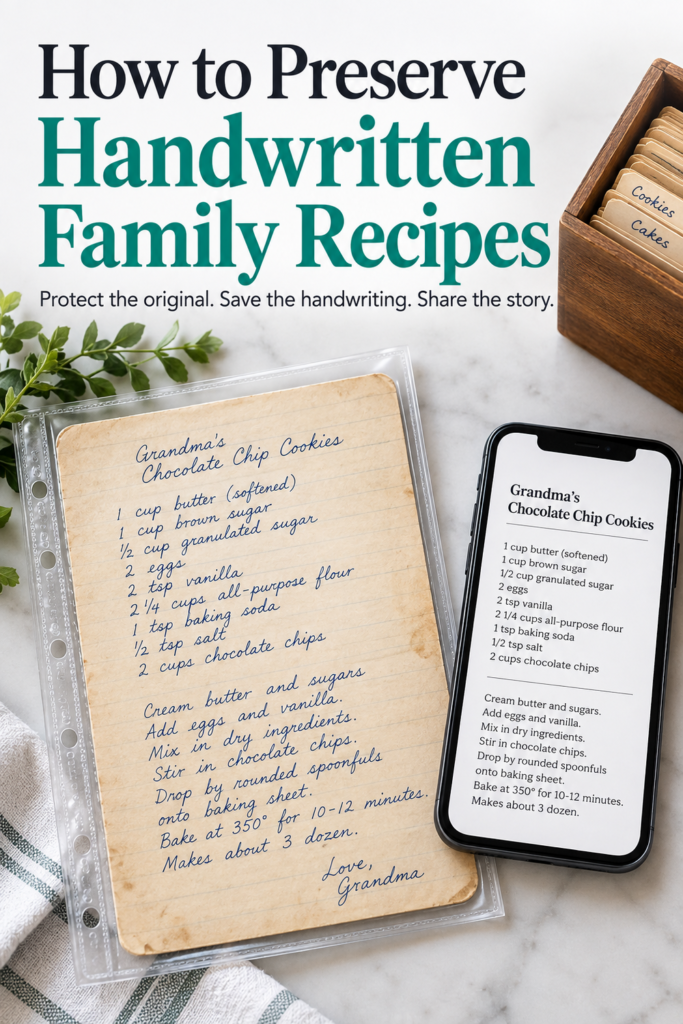
Those experiences shaped the rule I use now: protect the original and create a separate working copy. Most of my practical recipe collection lives in Plan to Eat, but a few recipes are sacred enough to remain analog too. The handwritten version deserves safe storage, while a scan, transcription, printout, or digital copy can handle the cooking and sharing.
What Should You Do First With Old Handwritten Recipes?
If you have just inherited a box, binder, or stack of recipes, resist the urge to start taping, sorting, or scrubbing. First, make the area safe and document what you received.
Do this first:
- Wash and completely dry your hands.
- Clear a clean, dry workspace.
- Move food and drinks away from the table.
- Take a quick photo of the entire collection before sorting.
- Separate obviously damp, moldy, or pest-damaged pieces from the rest.
- Do not tape, glue, laminate, mount, or flatten anything yet.
Work with one small group at a time. If the cards arrived in a particular order, photograph that order before changing it. A divider, envelope, or note that seems unimportant now may help identify who owned the recipes or how the collection was used.
Decide What Recipes You Are Trying to Preserve
One family recipe can contain three different things worth saving. Each one needs a slightly different method.
| What you want to preserve | Best method | What it protects |
|---|---|---|
| The original paper | Preservation-quality sleeve or enclosure | The physical card, ink, stains, and handwriting |
| The recipe and handwriting | Clear scan or photograph of both sides | The complete visual record |
| The family story | Written notes, names, dates, memories, and a transcription | The context future generations will not automatically know |
You do not have to choose only one. The best family archive includes the protected original, a digital image, and the story connected to it.
My Meema’s casserole is a good example. The small notebook page preserves her handwriting. My recipe-box copy gives me an analog version I can use. A digital working copy can protect both pieces from the grease, water, and general chaos that come with cooking for a family.
How to Digitize Handwritten Recipe Cards
Digitizing gives you a copy that can be shared, backed up, and used without repeatedly handling the original. You can use a flatbed scanner when the card lies comfortably flat, or a phone or camera when pressing the item against scanner glass could damage it.
Scan or photograph both sides
Always check the back. It may contain substitutions, cooking times, names, dates, grocery notes, or a completely different recipe. Capture the entire front and back, including worn edges and blank areas that show the card’s size and condition.
Create one clear master copy
Use even lighting and avoid shadows or glare. Place the card on a plain, contrasting surface, keep the camera directly above it, and make sure every word is in focus. Do not force a curled, folded, or fragile recipe flat just to make a prettier image.
Review each image before putting the card away. Zoom in and confirm that you can read the smallest writing. Keep the clearest, full-size version as your master copy. You can make smaller copies later for email, recipe apps, or social sharing.
Type a readable version too
The scan should preserve the recipe exactly as it appears, including original spelling, shorthand, and crossed-out notes. Create a separate transcription for cooking. In that version, you can expand abbreviations, arrange the ingredients in order, and add a note when a measurement or direction is unclear.
Do not silently guess. If the card says something that might be “1 tsp.” or “1 tbsp.,” mark it as uncertain and ask the relatives who remember the dish.
Name the files consistently
A descriptive filename is far more helpful than a folder full of images named with random numbers. Use the same pattern for every recipe:
Recipe Name - Writer - Approximate Year - Front
Recipe Name - Writer - Approximate Year - Back
If you do not know the writer or date, use “Unknown Writer” or an estimated decade instead of leaving out the information.
What Information Should You Record With a Family Recipe?
The card cannot tell future family members everything you know today. Record the details while someone still remembers them.
- Recipe name
- Writer’s full name and family relationship
- Approximate date or decade
- Where the card or page came from
- Holiday, event, or season connected to the dish
- Who remembers eating or making it
- Unclear measurements, ingredients, or directions
- Changes the family normally made
- Who currently holds the original
Package sizes, ingredients, and kitchen equipment change over time. A note that the recipe used an older cake-mix size, a woodstove, or vegetables from a particular family garden can make the instructions easier to understand and the story more meaningful.
Would you like to save this?
The story may be the detail that turns an ordinary recipe into a family heirloom. If I passed down only the broccoli rice casserole instructions, my children would not automatically know that it was the one dish my Meema made well enough for everyone to request. A copy of my great-aunt’s recipe would also lose part of its meaning if nobody recorded whose handwriting appears on the page or why my grandmother held onto it for so long.
How to Store Original Recipe Cards Safely
The National Archives recommends clear polyester film sleeves or preservation-quality loose-leaf album pages with polyester page protectors for family recipes. It also warns that magnetic or self-stick albums can discolor paper and make items difficult to remove safely.
Choose preservation-quality materials from a reputable archival supplier. Store the protected cards flat and supported in an appropriate box, binder, or album. Keep the collection in a clean part of the home away from direct sunlight, moisture, kitchen grease, pests, and large changes in temperature or humidity.
Do not keep an irreplaceable card beside the stove or sink. A protective sleeve may help during handling, but safe storage and a separate kitchen copy provide much better protection.
If a recipe is brittle, moldy, stuck to another item, badly torn, or flaking, stop handling it. A qualified paper conservator can advise you without risking a repair that causes more damage.
What Should You Avoid Doing to Old Recipe Cards?
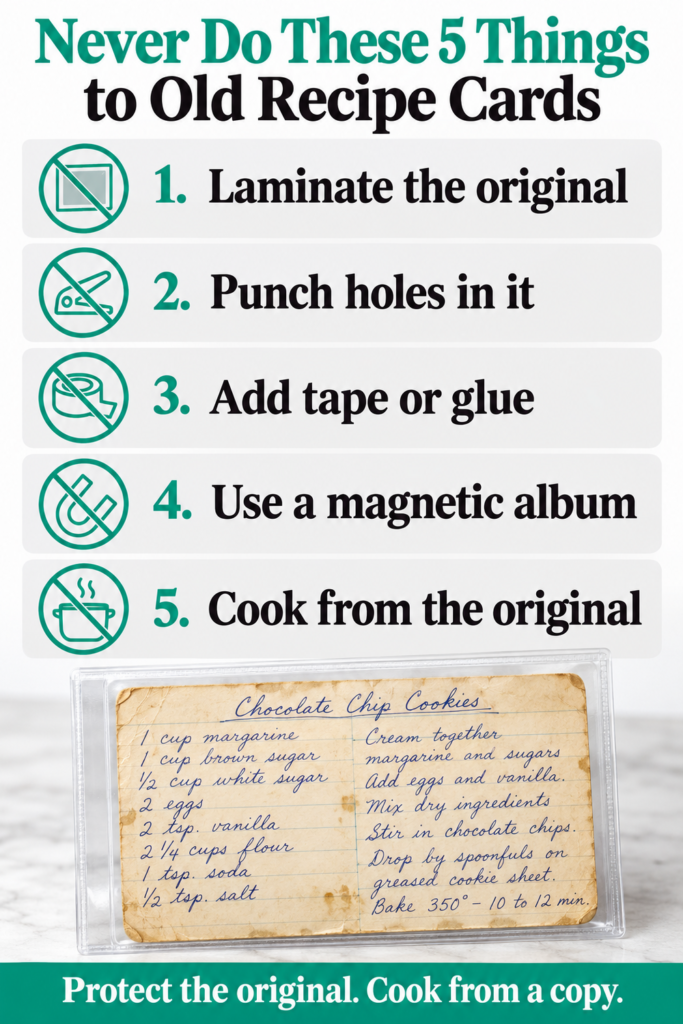
Protect the original. Do not:
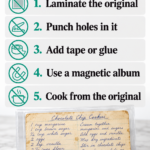
- Laminate an irreplaceable original.
- Punch holes in the card.
- Attach it with tape, glue, or scrapbook adhesive.
- Put it in a magnetic self-stick album.
- Write corrections directly on it.
- Keep cooking from the original beside the stove.
These changes can be permanent, cause discoloration, hide information, or make future conservation harder. If you want a wipeable card, a ring of recipes, or a decorated scrapbook page, make those from high-quality copies.
This is also where preservation and crafting need to stay separate. Your original card can remain protected while a copy becomes part of a beautiful scrapbook for recipes.
Affiliate disclosure: I have used and paid for Plan to Eat since 2020. If you join through my referral link, you receive 20% off your first annual subscription payment, and I may earn a commission from qualifying subscription payments at no additional cost to you.
Make a Working Copy for the Kitchen
Once the original is safe, make the recipe convenient enough to use. You can:
- Print a copy of the scan.
- Type and print a clean version.
- Add the typed recipe to a family binder.
- Enter the recipe into Plan to Eat.
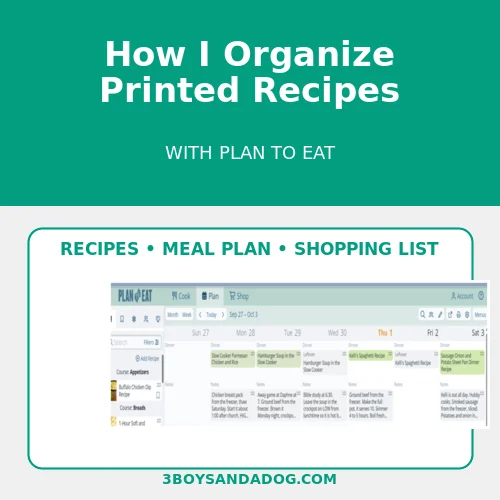
I have paid for Plan to Eat since February 14, 2020, and it is the working home for most of the recipes I actually cook. I plan on my computer because that is easiest for me, but I also keep the app on my phone. For a printed or handwritten recipe, I can photograph it, review and correct the imported ingredients and directions, then organize it with categories and tags. The original handwriting stays preserved in the scan while the cleaned-up recipe becomes searchable and usable.
My Plan to Eat calendar connects to Google Calendar, which then connects to our Skylight. That lets the kids see the meal plan without asking me what is for dinner over and over. Once I plan the meals, the ingredients feed into my shopping list. I can send selected items to Walmart or Instacart, check the brands and quantities, and finish the order. That entire loop, from deciding what to cook to filling the grocery cart, is why Plan to Eat works better for me than relying only on binders and recipe boxes.
I also added a Save to Plan to Eat button to every recipe on 3 Boys and a Dog. If you find one of my recipes that you want to try, you can save it directly to your own account instead of copying and pasting it. You can see the full system in How I Organize Printed Recipes With Plan to Eat.
Try Plan to Eat and receive 20% off your first annual subscription payment
How to Share One Recipe With the Whole Family
Several relatives can share the recipe without passing the only original from house to house. Give each person the complete set whenever possible:
- A clear image of the front and back
- The readable transcription
- The writer’s name and approximate date
- The family story and any memories connected to the dish
You can place the files in a shared family folder, print binders for different households, build a private digital recipe collection, or create a family cookbook. Sharing the story with the instructions keeps the recipe from becoming an anonymous list of ingredients a generation from now.
Back Up the Digital Copies
A digital file is not a backup if it exists in only one place. Keep the working files on your main device, another copy in cloud storage or on an external drive, and one more copy with a relative or in another location.
Use the same folders and filenames in each location so the collection stays understandable. Add new scans and notes to the backups as you continue the project instead of waiting until everything is finished.
Turn Preserved Recipes Into a Usable Family Collection
Preservation does not have to turn the recipes into museum pieces that nobody uses. I can protect the scrap of notebook paper with my Meema’s casserole, keep my own handwritten recipe-box copy, and still put a practical version into the system I use every week.
That balance is the goal. Organize the typed versions by meal, ingredient, holiday, or family member. Add notes after you test an unclear direction. Put recipes on your meal plan, share them with relatives, or use copies in a scrapbook. Protect the paper and handwriting, but keep making the food. After all, a recipe becomes part of a family’s story because people continue gathering around it.
Choose what you want to do next:
Once I started sorting old family recipes, practical questions came up quickly, especially when the paper was fragile or the handwriting was hard to read. These are the answers I would want my own family to have before handling the originals or moving a treasured recipe into Plan to Eat.